Project Scope and Results
Advancing digital design of robust composite structures
The DIDEAROT project develops digital engineering technologies that enable faster and more reliable design, manufacturing and certification of advanced composite aircraft structures. By combining high-fidelity physics-based simulations, machine learning and high-performance computing (HPC), the project aims to reduce the dependence on costly experimental testing while improving confidence in virtual certification. The research covers the complete digital engineering workflow, from manufacturing-induced distortions to structural damage prediction under service loading.
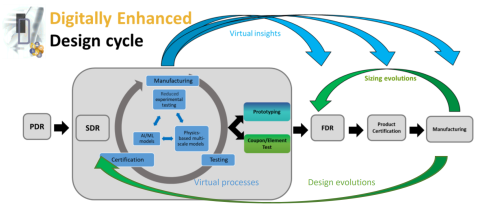
Figure: Overall DIDEAROT digital workflow
Hybrid simulation and artificial intelligence
One of the project's main achievements is the integration of machine learning with conventional finite element simulations. Instead of replacing physics-based models, AI surrogate models are trained using high-fidelity simulation and experimental datasets, allowing engineers to predict complex material behaviour several orders of magnitude faster while preserving engineering accuracy.
These hybrid models enable efficient exploration of manufacturing parameters and structural configurations that would otherwise require computationally expensive simulations. HPC resources are used both to perform detailed simulations and to generate synthetic datasets for training the machine learning models.
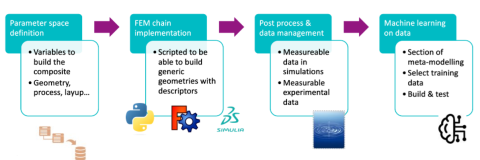
Figure: Hybrid modelling strategy combining HPC simulations and machine learning.
Damage simulation of composite structures
Multi-scale damage prediction
DIDEAROT develops advanced multi-scale numerical models capable of representing damage mechanisms from the material microstructure up to the structural level. Physics-based models capture fibre failure, matrix cracking and other degradation mechanisms, while AI-based surrogate models reproduce the nonlinear material response efficiently during structural simulations.
Recent developments include recurrent neural network surrogates for history-dependent composite behaviour and deep material network approaches that accelerate multi-scale damage analyses without sacrificing prediction quality. These methods substantially reduce computational costs while maintaining the ability to model complex loading histories.
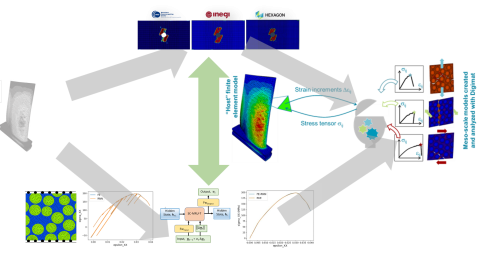
Figure: Multi-scale damage modelling from material microstructure to structural component.
AI-accelerated material response
Several project developments focus on replacing computationally intensive homogenisation procedures with machine learning surrogates. Deep Material Networks and recurrent neural networks have been developed to predict nonlinear, stochastic and damage-dependent material behaviour over complex loading paths.
These surrogate models enable efficient virtual testing of composite structures while remaining consistent with detailed numerical simulations. The resulting computational speed-up makes large-scale optimisation and certification-oriented simulations practical.
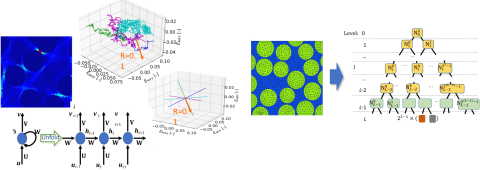
Figure: Deep Material Network architecture and surrogate prediction concept.
Source: EASN 2024 presentation (damage modelling section).
Process simulation of composite manufacturing
Predicting manufacturing distortions
Manufacturing-induced distortions remain one of the principal challenges in producing large composite aerostructures. DIDEAROT develops high-fidelity process simulation workflows capable of predicting residual stresses, curing distortions and assembly deviations before manufacturing takes place.
These simulations are combined with reduced-order and surrogate models that allow rapid evaluation of manufacturing scenarios while maintaining the fidelity of detailed thermo-mechanical process simulations.
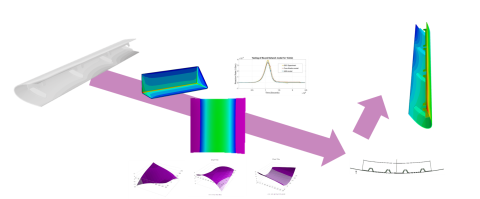
Figure: Process simulation workflow showing curing distortion prediction.
Surrogate models for manufacturing optimisation
An important project outcome is the development of machine learning surrogates for predicting process-induced distortions. High-fidelity HPC simulations generate synthetic datasets that train AI models capable of rapidly estimating manufacturing outcomes for different laminate configurations and process parameters.
These tools significantly reduce simulation time and support design optimisation by allowing engineers to evaluate many design alternatives early in the development process.
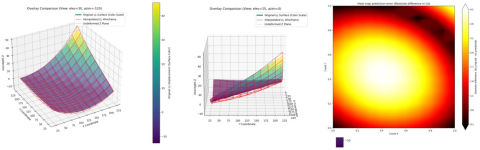
Figure: Comparison between high-fidelity simulation and surrogate prediction of composite distortion.
Project impact
The developments achieved within DIDEAROT contribute to a new generation of digital engineering tools for composite aircraft structures. By combining advanced simulations, artificial intelligence and high-performance computing, the project enables:
- faster design iterations through AI surrogate models;
- improved prediction of manufacturing distortions and residual stresses;
- efficient multi-scale damage simulation;
- reduced computational cost for virtual certification workflows;
- increased confidence in digital testing methodologies for future aerospace structures.